
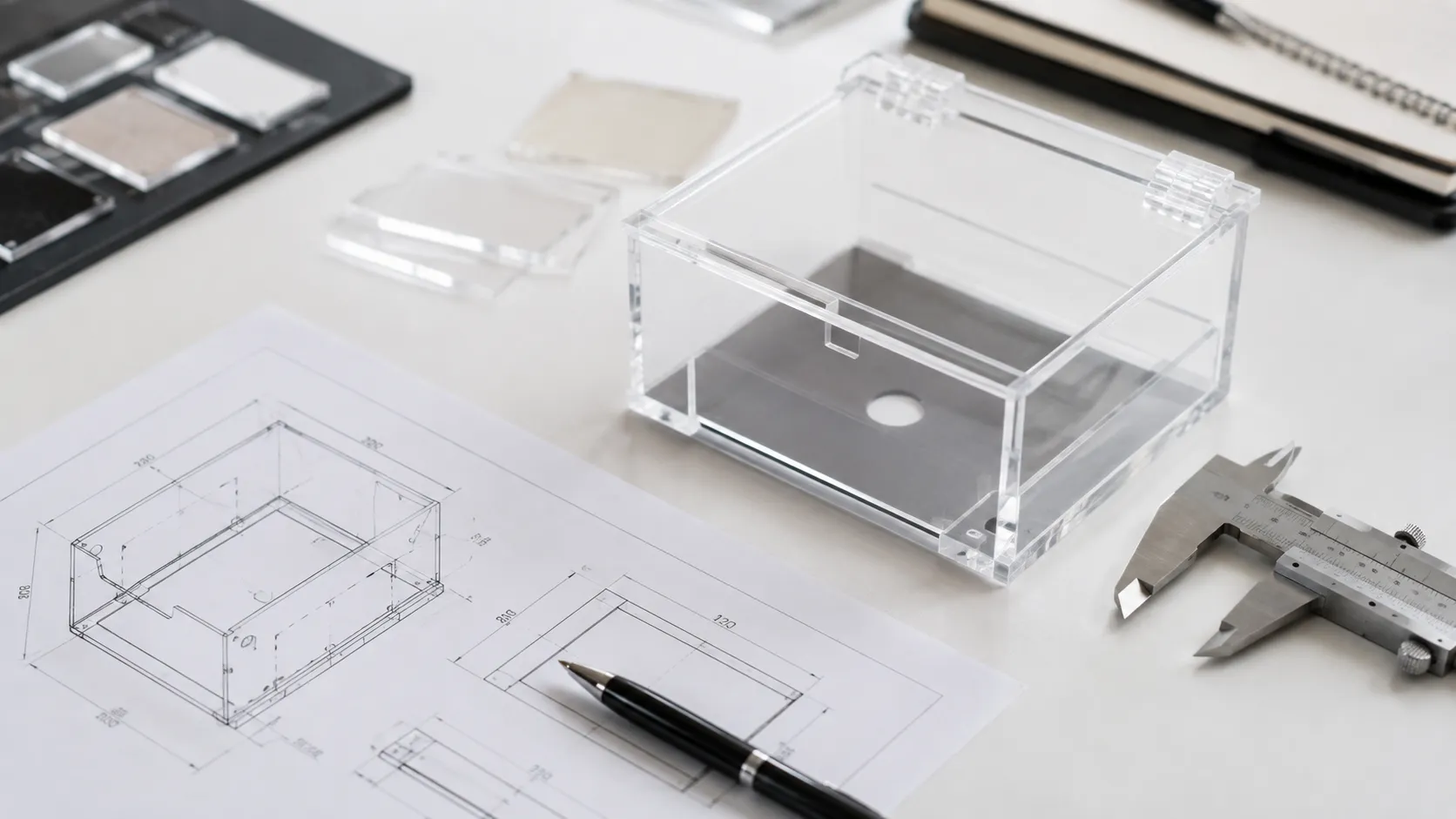
Custom acrylic products often look simple.
A clear box, display stand, cover, or holder may only contain a few panels.
But small dimensional differences can affect the whole structure.
In one custom acrylic project, the customer first provided the general product concept and required size.
Before asking the factory to make the sample, we reviewed several details:
- external dimensions
- internal usable dimensions
- acrylic thickness
- opening direction
- assembly method
- edge finishing
- logo position
- tolerance between moving parts
One important point was the relationship between the outside size and the inside space.
With acrylic products, the material thickness takes up part of the internal dimension.
For example, changing from 3 mm acrylic to 5 mm acrylic does not only make the product stronger.
It can also reduce usable internal space and affect sliding lids, inserts, or components placed inside the box.
After confirming the structure, the factory prepared the first sample.
The sample was then checked against the drawing and the customer’s intended use.
When necessary, we adjusted small details before preparing for mass production.
This process is especially important for products with:
- sliding lids
- magnets
- removable panels
- fitted inserts
- display grooves
- tight internal tolerances
What this case shows
A drawing is the starting point.
A good sample helps confirm whether the drawing, material thickness, tolerance, appearance, and real-world use actually work together.